Combined development: Tecuamburro + Infiernitos, 25-year forecast
Tecuamburro Volcanic Complex, Guatemala · Two-resource joint developmentBrief
Test whether developing Tecuamburro and Infiernitos as one combined project changes either resource's own forecast, using a framework where every combined-scenario sample shares the identical natural-state realisation, injection strategy and pump-sizing logic as its single-resource counterpart.
Challenge
Determine whether joint development causes genuine resource-scale interaction — shared pressure support, competition for reinjection capacity — or whether independent forecasts simply sum, and prove it at the level of reservoir pressure itself rather than inferring it from power output alone.
Method
293-sample stochastic ensemble; automated well-siting growth algorithm; source-network-coupled reinjection in Waiwera; matched sample-by-sample against each resource's independent forecast; interference tested directly via per-sample reservoir pressure at Infiernitos' own feedzones.
Outcome
Combined development changes each resource's own forecast by under 1% (Wasserstein-1 distance 0.13–0.38 MWe), and the distributions are not statistically distinguishable (Kolmogorov–Smirnov, p>0.05). A real but small hydraulic interference exists — 0.18 bar median pressure reduction at Infiernitos by year 25 — an order of magnitude below natural-state uncertainty.
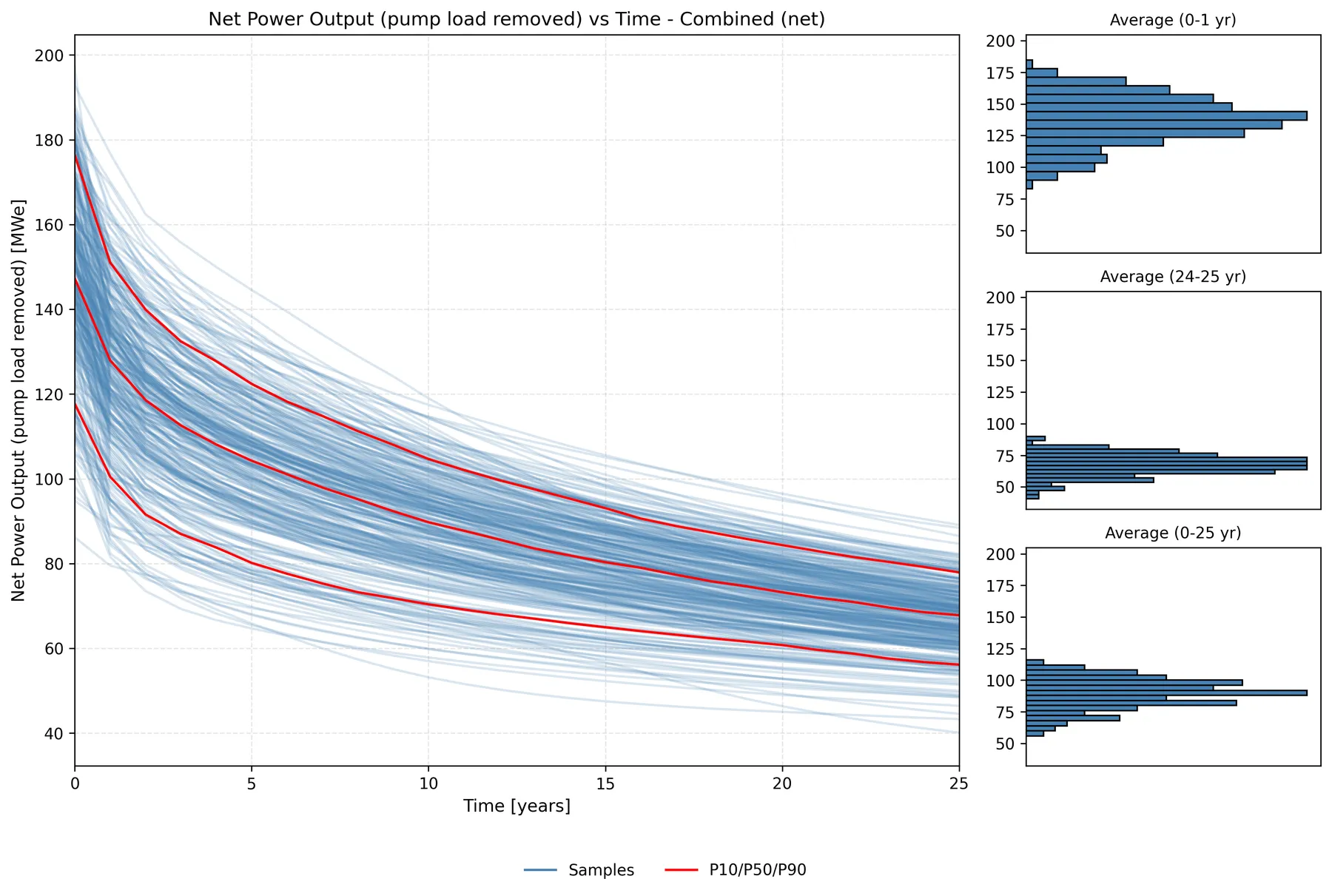
Combined net power output, 25-year forecast, 293-sample ensemble — grey: individual samples; red: P10/P50/P90
P1071.4 MWe
P5089.9 MWe
P90104.4 MWe
25-year time-averaged net output across the ensemble (mean 89.3 MWe)
From our own in-preparation manuscript on Tecuamburro–Infiernitos combined resource assessment — not yet peer-reviewed.